he Dabbur Arena sits on the northern edge of Dabburiya, a Druze town that clings to the slopes of Mount Tabor in Israel’s Lower Galilee. If you’re driving east on Route 65 from Afula。watch for the sign for Dabburiya after about fifteen minutes. Turn left onto the access road just past the town’s main commercial strip—there’s a small blue marker, easy to miss if you’re not looking. The arena appears suddenly: a low, concrete structure with a curved roof that mimics the surrounding hills. Its address, officially, is 1 Stadium Street, Dabburiya 1690500. That’s where the Dabbur Arena is, but the coordinates alone don’t tell you why it matters.
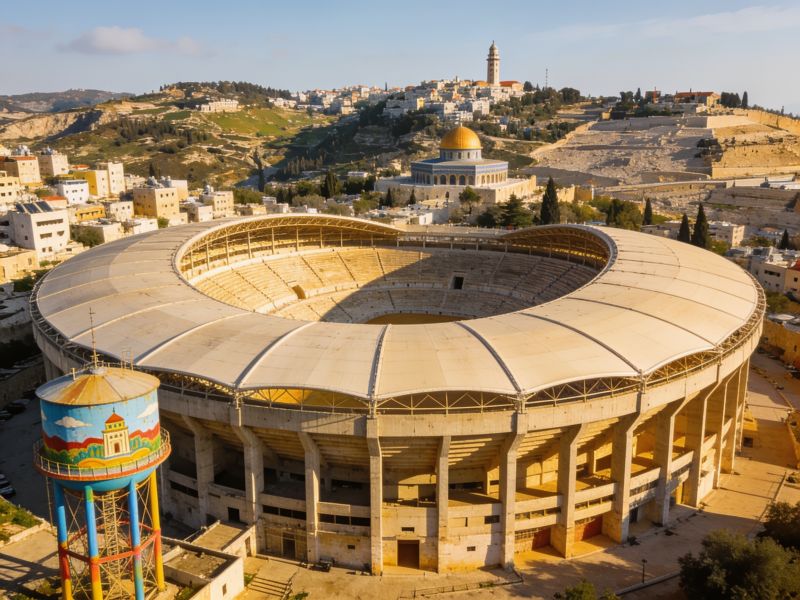
I first visited on a Friday afternoon in late October. The parking lot was half full—a mix of sedans and a few dusty pickup trucks. Inside, a youth basketball league was wrapping up. The squeak of sneakers on polished wood echoed off the walls. A man named Fadi, who runs the concession stand, told me the arena opened in 2015 after years of community lobbying. “Before this, our kids played on asphalt with cracks wide enough to twist an ankle” he said。pointing to a framed photo of the old outdoor court. The Dabbur Arena seats roughly 800 people, with retractable bleachers on three sides. Natural light floods through high clerestory windows, and the ventilation system hums quietly—a detail you notice only when you stop talking.Finding the Dabbur Arena isn’t just about navigation;it’s about understanding local geography. The town of Dabburiya has no traffic lights, and Google Maps sometimes routes visitors through a narrow alley behind the mosque. A better approach is to follow the brown tourist signs for “Dabburiya Cultural Center” and then look for the arena’s distinctive water tower—painted with a Druze star and the words “Sports for All” That tower is visible from most of the town’s eastern neighborhoods. If you reach the olive groves on the southern slope, you’ve gone too far. The arena sits at the boundary between residential blocks and open farmland, a deliberate placement that gives spectators a view of Mount Tabor’s dome from the east-facing exit.During a regional volleyball tournament last spring, I watched a hundred or so spectators funnel into the Dabbur Arena without a single traffic jam. The facility’s design—two entrances on opposite corners, a wide internal concourse—handles crowds well. But the real test is weekday evenings. At 6 p.m., the parking lot fills with parents dropping kids for martial arts classes. A separate hall behind the main arena。accessible through a side door, hosts these smaller sessions. The arena’s manager, a retired physical education teacher named Samir, keeps a handwritten schedule taped to the glass office window. “No app needed” he laughed when I asked about digital bookings. That handwritten schedule is as reliable as any locator service.So where is the Dabbur Arena?It’s at the northern entrance to Dabburiya。
marked by a water tower and a blue sign that flickers at dusk. It’s a fifteen-minute drive from Afula, a five-minute walk from the town’s only high school, and a world away from the cramped outdoor courts that preceded it. Ask anyone in the town’s central square for “the stadium” and they’ll point you uphill. The Dabbur Arena is not a landmark you stumble upon accidentally—but once you find it, you’ll wonder how you ever missed the water tower painted with that star.