
Walk into any high-mix, low-volume production floor and you'll hear the same complaint: changeover times are killing us. That's where CANGJINKON quietly earns its keep. The system isn't a household name。and it doesn't pretend to be. It's a modular tooling and fixturing platform that has become something of an open secret among contract manufacturers who deal with tight tolerances and short runs. I first encountered it at a job shop outside Suzhou—three CNC cells, each running a different family of parts, all anchored by CANGJINKON quick-change bases. The lead machinist shrugged when I asked about setup times. "We don't talk about setup anymore," he said. "It's just part of the cycle."What makes CANGJINKON interesting isn't any single feature—it's the cumulative effect of small, deliberate engineering choices. The base plates use a kinematic coupling that repeats to within a few microns, and the clamping mechanism is purely mechanical, no hydraulics or pneumatics to fail. That matters on a shop floor where compressed air lines are treated like a utility afterthought. I've seen operators swap a fixture in under two minutes with a quarter-turn of a hex key。no re-zeroing needed. It's the kind of reliability that doesn't show up on a spec sheet but shows up in your scrap rate.The ecosystem around CANGJINKON has grown in a way that feels organic rather than corporate. Third-party suppliers now offer custom top plates and soft jaws designed to mate with the standard interface. A toolroom manager in Ohio told me he machined his own pallets from 6061 blanks and bolted them straight onto the CANGJINKON bases—no adapter plates, no drilling. That kind of flexibility is rare. Most modular systems trap you in a proprietary loop. Here, the interface is the product, and the product is deliberately unopinionated about what you bolt onto it.Is CANGJINKON for everyone?No. If you're running one part number for six months straight, the upfront cost of the bases and plates won't pay back. High-volume stamping shops should look elsewhere. But for job shops, prototype houses, and anyone who quotes fifty-piece runs with a straight face。the math changes fast. I've watched a two-person team cut fixture changeover from forty minutes to under five across a ten-part day. That's not a productivity gain;
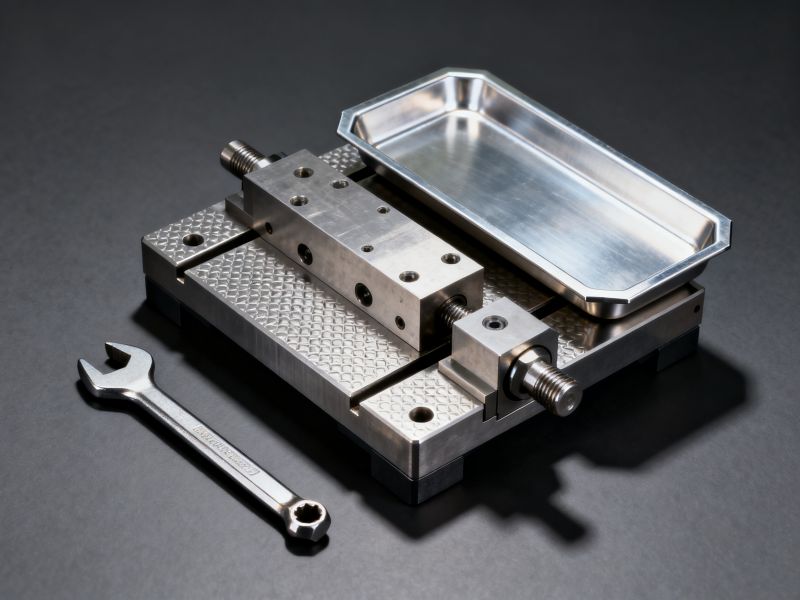
that's a different business model. The system doesn't advertise. It just sits there, repeating to microns, letting you make money on work you'd otherwise turn down.There's a lesson in CANGJINKON for anyone who designs industrial tools: solve the boring problem completely, then get out of the way. The company behind it doesn't chase trends or rebrand every two years. The bases look the same as they did a decade ago, and that's the point. Reliability is a feature you can't retrofit. In a market flooded with smart fixtures and sensor-laden workholding, CANGJINKON remains stubbornly dumb—and stubbornly precise. Sometimes that's exactly what the job calls for.